Facebook tracking pixel

Education

Tools for teaching loudness, dynamics, and critical listening.

Built for the Concepts You're Teaching

Loudness, dynamic range, and the way our ears can be fooled by level are some of the trickiest concepts to teach in an audio engineering curriculum. They're easy to describe, but hard to show.

MeterPlugs meters are designed to make these concepts visible and audible in real time. Three plug-ins in particular have become classroom favorites: K-Meter for level and dynamic-range awareness, Dynameter for teaching dynamics independent of loudness, and Perception AB for demonstrating the loudness deception with level-matched A/B comparisons.

K-Meter

A modern take on classic VU and RMS metering.

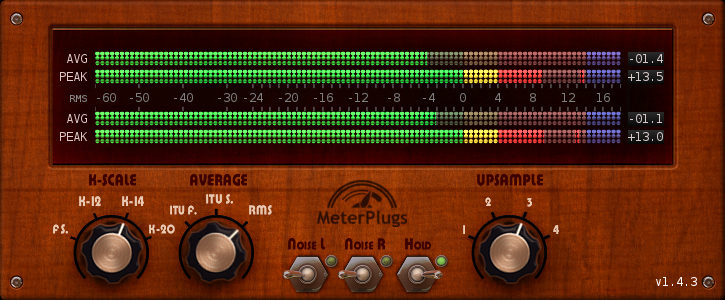
K-Meter screenshot

Before peak meters became the default, engineers worked with VU and RMS meters that tracked perceived loudness, not just peak level. K-Meter brings that approach back, with full support for Bob Katz's K-System — a metering standard built around dynamic range rather than chasing peak levels.

For students, K-Meter is a gentle introduction to the relationship between RMS, peak, and headroom — and a practical tool for calibrating monitors with pink noise. The three K-System scales (K-12, K-14, K-20) give a clear framework for discussing how dynamic-range targets vary across broadcast, popular music, and film.
Dynameter

See dynamics, independent of loudness.

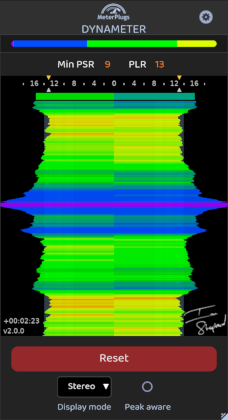
Dynameter screenshot

Streaming services now normalize playback loudness, so the conversation in mixing and mastering has shifted from "how loud?" to "how dynamic?" Dynameter is a real-time dynamics meter built for that conversation. It measures PSR and PLR — how much headroom a track has above its average loudness — and colour-codes the result so students can see, at a glance, when a mix is breathing and when it's been crushed.

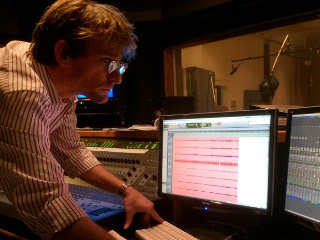
David McKenna, Post Production and Scoring Stage Manager at UCLA's School of Theatre, Film and Television, uses Dynameter in his intermediate recording class:

David McKenna
By applying Dynameter on every channel of my first progression of songs, there was an easy to see evolution where the mixes went from plump green, to yellow, to orange, to red, to brown, and ultimately ashen grey. Every student got it. David McKenna (UCLA School of Theatre, Film and Television)

Read the full conversation with David on the MeterPlugs blog.

Perception AB

Demonstrate the loudness deception.

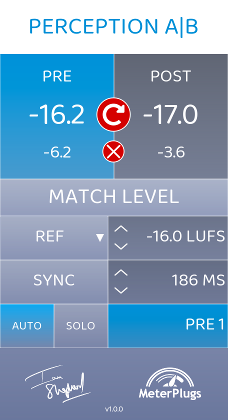
Perception AB screenshot

A louder mix almost always sounds better — even when it isn't. This is one of the hardest things for students to hear for themselves, because the difference in level masks every other change.

Perception AB makes the demonstration trivial. Insert one instance before a processing chain and one after, click "Match Level," and students can A/B the two states at the same perceived loudness. Suddenly the question shifts from "which is louder?" to "which is actually better?" — and the answers stop being obvious. It's a small piece of software that changes how a class listens.

Educational Pricing

Discounted licenses for schools, programs, and instructors.

We offer educational pricing for all of our products — whether you're an individual instructor putting a few plug-ins on your teaching machine or a program licensing them across a lab.

Contact us for details